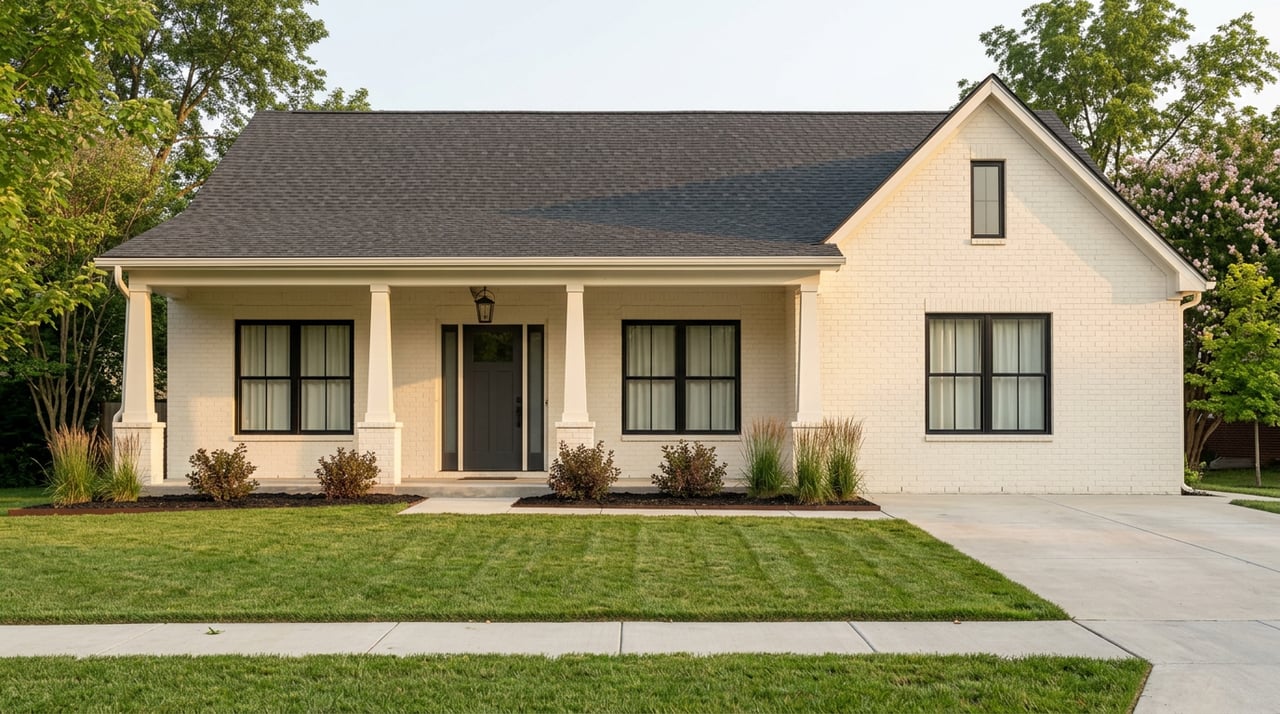
Why Two Reports Say Pea Ridge Home Prices Are Both Rising and Falling
August 13, 2026
August 13, 2026
Pull two market reports on Pea Ridge right now and you'll walk away with two different stories. One tracker's May 2026 read put the median sale price at $321,875, down 14.8 percent from a year earlier. Another, updated around the same stretch of 2026, showed the average sale price at $375,000, up 15 percent year over year. Same town, overlapping timeframes, opposite directions.
That's not a data error. It's the clearest signal in the entire Pea Ridge market right now, and it tells you something the citywide median never will: this isn't a town where demand is cooling. It's a town where the mix of what's selling is changing faster than any single number can keep up with.
Ridley's May 2026 market read put Pea Ridge's median home price at $321,875, down 14.8 percent year over year, against a statewide gain of 2.9 percent. That same report flagged 2.3 months of supply, well under the 5-month threshold considered balanced, and noted that 25.8 percent of active listings had already taken a price cut, against a stated statewide average of 0 percent.
Redfin's tracker, updated around the same stretch of 2026, told a different story: an average sale price of $375,000, up 15 percent from a year earlier. Movoto's April 2026 figures landed in between, with a median sold price of $344,990.
None of these sources are wrong. They're measuring different slices of the same market at the same time, and in a town where new construction is arriving faster than resale turnover, that slicing matters more than usual. When a large batch of new, moderately priced homes closes in the same window as a handful of higher-end resale sales, the median can swing hard in either direction depending on which transactions land in which month. A falling median doesn't necessarily mean existing homes are losing value. It can mean the mix of what closed escrow just shifted toward more affordable new construction.
The mix shift has a clear source. Builder listings across Pea Ridge currently span 19 new communities from 5 active builders, with prices running from $203,400 up to $685,000 and floor plans between 869 and 3,177 square feet. D.R. Horton and Schuber Mitchell Homes are both actively building in the city, and Schuber Mitchell markets its Pea Ridge communities directly on proximity, close enough to Bentonville's downtown dining, Rogers' Beaver Lake, and Bella Vista's golf courses to appeal to buyers priced out of those markets but unwilling to give up access to them.
That pitch is landing. Movoto's April 2026 data shows 413 homes sold in Pea Ridge that month, up from 251 the year before, a jump of roughly 65 percent in transaction volume. Major residential development is also underway near Big Sugar Creek Golf Course, adding another pocket of new product south of town.
A regional growth tracker covering Northwest Arkansas noted in late May 2026 that cities including Centerton, Pea Ridge, and Farmington are absorbing buyers who are increasingly willing to live farther from the region's core employment centers in exchange for lower entry prices. Pea Ridge isn't growing because it suddenly became more desirable in isolation. It's growing because it's where the new supply is.
Here's the part that surprises buyers who assume rising sales volume always signals a hotter market. Alongside that 65 percent jump in homes sold, the average time on market in Pea Ridge stretched to 77 days in April 2026, up from 49 days the year before, according to Movoto.
That combination, more sales and longer time to close them, is exactly what you'd expect when a market absorbs a wave of new construction rather than working through a fixed pool of existing homes. New-build inventory doesn't sell at the pace of a hot resale market with limited supply. It sells at the pace builders can market, finance, and hand off, which stretches the average days-on-market figure even while total sales climb. A buyer reading "77 days on market" as a sign of a slow, buyer-favorable market isn't wrong exactly, but they're missing that the slowdown is a supply story, not a demand story.
None of this new construction happens without utility capacity to support it, and Pea Ridge has been working on that piece directly. In a city update shared in July 2026, Mayor Nathan See detailed an upgrade to the Easterling Lift Station, which increases sewer capacity for future residential and commercial development. The city expects that project finished by January 2027. "We look forward to doing more on this basin for quality of life and to build a sense of community," See said in the announcement covered by KNWA/KFTA.
The city is also investing in connectivity on the ground. A $102,000 sidewalk project will link the Wellington and Arlington neighborhoods, funded in part through an 80/20 grant administered by the Arkansas Department of Transportation. Downtown has also seen sidewalk repairs near a local school after a walkability study flagged unsafe stretches, part of a broader push to make the city center more walkable as more housing lands around it.
None of this is the kind of detail that shows up in a portal search, but it's the reason builders keep choosing Pea Ridge over towns with tighter utility constraints. Sewer capacity is the quiet gatekeeper of how much new supply a town can actually approve, and Pea Ridge just bought itself more room to keep building through at least early 2027.
If you're comparing Pea Ridge to Bentonville on price alone, the same mix-shift problem shows up there too, just with different numbers. A closing-price tracker following Bentonville's 72712 and 72713 zip codes found a median closing price of $449,000 across 575 tracked sales over the six months ending in August 2026, with the middle half of those sales closing between $340,000 and $679,000. A separate market report, anchored to January 2026 sales activity, put Bentonville's median at $489,500, up 8.78 percent year over year. Redfin's February 2026 read showed a median sale price of $418,000, down 19.6 percent from a year earlier.
That's three credible sources landing anywhere from $418,000 to $489,500 for the same city across three overlapping reads from the first eight months of 2026. The lesson is the same one Pea Ridge teaches: a citywide median tells you almost nothing about what a specific house in a specific neighborhood is actually worth. It tells you what closed, blended across every price point and every kind of home that happened to sell that month.
Here's the piece that gets lost when buyers treat the Pea Ridge-versus-Bentonville comparison as a simple discount. The gap isn't really about distance from Walmart's home office or the drive time to downtown Bentonville. It's about the age and type of housing stock each city is currently building and selling.
Bentonville's transaction mix skews toward established neighborhoods with a wide range of home ages and a smaller, pricier new-construction pipeline. Pea Ridge's mix right now is dominated by brand-new subdivisions priced from the low $200s to the high $600s, sitting alongside an established resale market in neighborhoods buyers will recognize from current listings, among them Woods Creek, Creekside, Stonehenge, Otter Creek Estates, Chapel Hill, and Cross Creek. When new construction makes up a larger share of what's selling, the citywide median naturally sits lower, not because comparable homes are worth less, but because more of what's selling is smaller, newer, and priced for a first-time or move-up buyer rather than a move-up-from-Bentonville buyer.
For a buyer actually comparing the two towns, the useful question isn't "what's the median in each city." It's "what does a home of this age, this size, and this finish level cost in each place." That answer holds up a lot better than any single headline number, and it's the one worth asking before you write an offer in either direction.
Is Pea Ridge actually cheaper than Bentonville, or is that a mix-shift illusion too? Both are true at once. Comparable homes, same age and size, do tend to cost less in Pea Ridge. But part of the gap in the citywide medians reflects the fact that Pea Ridge's current sales mix leans more heavily toward new, smaller-footprint construction than Bentonville's does right now.
Should I wait for Pea Ridge prices to drop further before buying? The falling median in some reports reflects new construction entering the mix, not existing homes losing value. Months of supply sat at 2.3 as of the most recent read, well under the 5-month level that would signal a buyer-favorable market. That's tight enough that waiting on a broad price drop across the board isn't well supported by current conditions.
Does the sewer capacity upgrade affect homes that are already built? Not directly. The Easterling Lift Station project targets capacity for future development. If you're buying an existing home in an already-established neighborhood, this mainly matters as a signal of how much new supply is coming to the area around you over the next year.
If you're weighing Pea Ridge against Bentonville, or trying to figure out what a specific home in either market is actually worth once you look past the headline number, Sammie Beaver can walk you through the comps that matter for your price range and timeline. Reach out for a home valuation and design consultation before you write your next offer.
Whether you're buying, selling, building, or simply exploring your options, I’m here to offer personalized guidance, creative insight, and local expertise every step of the way.
Address
809 S 52ND ST
ROGERS AR 72758